
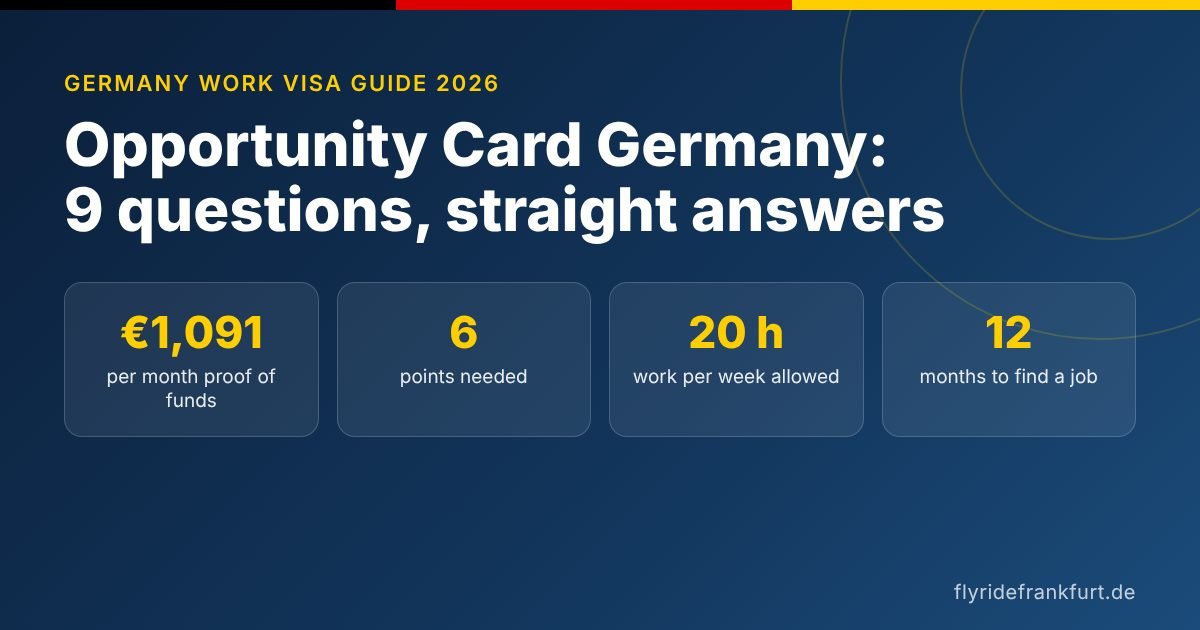
Every week, thousands of people type the same thing into Google, Reddit and AI chatbots: “How do I actually get to Germany for work?” In 2026 the answer usually starts with two words: Opportunity Card (Chancenkarte) or EU Blue Card. Here are the questions people ask most, answered in plain language.
Also available in: Deutsch | اردو
✈ Landing at Frankfurt Airport? We pick you up right at the terminal at a fixed price. Book your airport ride
1. What is the Opportunity Card Germany?
The Opportunity Card (Chancenkarte) is a residence permit that lets you live in Germany for up to one year while you look for a job. Think of it as a “come and search” visa. You do not need a job offer before you arrive.
2. What are the requirements for the Opportunity Card Germany?
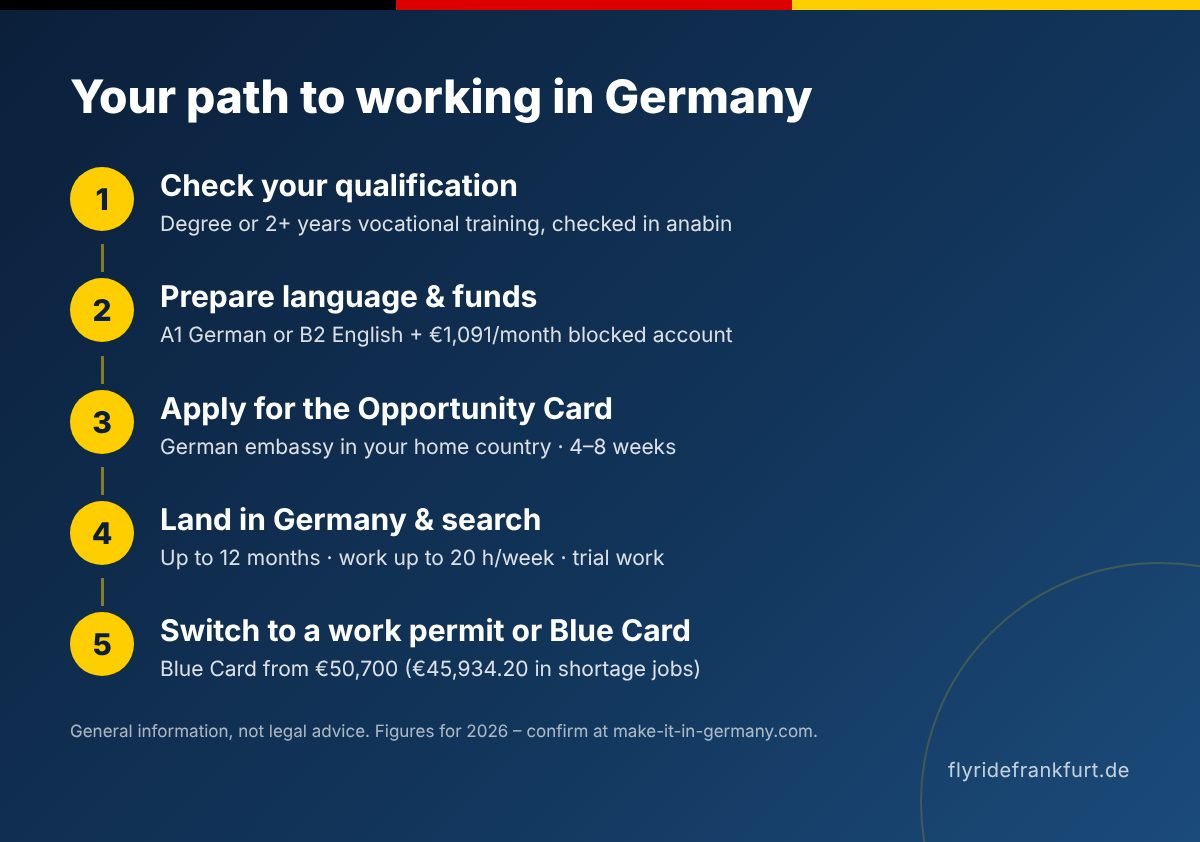
- A qualification: a university degree or at least two years of vocational training, recognised by the state where you got it.
- Basic language skills: German at A1 level, or English at B2.
- Money to live on: at least €1,091 net per month in 2026, usually shown through a blocked account (about €13,092 for a full year).
If your foreign qualification is already fully recognised in Germany, you qualify directly. If not, you need at least 6 points.
3. How does the Opportunity Card points system work?
| Criterion | Points |
|---|---|
| Partly recognised qualification | 4 |
| German B2 or higher | 3 |
| 5+ years of work experience (last 7 years) | 3 |
| German B1 | 2 |
| 2+ years of work experience (last 5 years) | 2 |
| Age under 35 | 2 |
| Age 35–40 | 1 |
| German A2 | 1 |
| English C1 or native speaker | 1 |
| Job in a shortage occupation | 1 |
| Previous 6+ month legal stay in Germany (last 5 years) | 1 |
| Spouse/partner also qualifies | 1 |
Real-life example: a 29-year-old software developer with 3 years of experience and B1 German scores 2 (age) + 2 (experience) + 2 (German B1) = 6 points. Enough.
4. Can I work while I am searching?
Yes. You may work up to 20 hours per week in any job, and you can do trial work of up to two weeks per possible employer.
5. How long is the Opportunity Card valid, and can I extend it?
It is valid for up to 12 months. The normal next step is to find a job and switch to a work permit or an EU Blue Card from inside Germany. If you have a qualified job offer but no other permit fits yet, you can get a follow-up Opportunity Card for up to two more years.
6. Can I apply for the Opportunity Card while I am already in Germany?
In most cases you apply at the German embassy or consulate in your home country. If you already live in Germany legally, ask your local foreigners’ office (Ausländerbehörde) whether you can switch. Processing usually takes 4–8 weeks, but busy embassies can take longer.
7. What is the EU Blue Card, and how much do I need to earn in 2026?
The EU Blue Card is for people who already have a job offer at a qualified level. The 2026 minimum gross salaries are:
- €50,700 per year for most jobs
- €45,934.20 per year for shortage jobs (IT, engineering, science, healthcare) and for IT specialists without a degree but with 3+ years of experience
8. Opportunity Card or Blue Card: which one is right for me?
| Your situation | Best option |
|---|---|
| No job offer yet | Opportunity Card |
| Job offer above €50,700 (or €45,934 in shortage fields) | EU Blue Card |
| Job offer below the threshold | Skilled-worker visa |
9. What is changing next?
The German government is building a “Work-and-Stay Agency”: one digital portal for visas, qualification recognition and residence permits. The cabinet approved the plan on 5 November 2025. When it launches, applicants should be able to track their case online instead of chasing several offices.
3 tips most guides do not tell you
- Start recognition early. Check your degree in the official anabin database before you apply; it saves weeks.
- Learn A2 German, not just A1. It adds a point and makes daily life and job interviews much easier.
- Use the 20 hours wisely. A part-time job in your own field is the fastest bridge to a full contract.
Which German airports should I fly into?
Besides Frankfurt (FRA), Germany’s main international airports are Munich (MUC), Berlin (BER), Düsseldorf (DUS), Hamburg (HAM), Stuttgart (STR) and Cologne/Bonn (CGN). Fly into the one closest to your new home or employer. FlyRide offers fixed-price transfers from all of these airports.
Landing at Frankfurt Airport?
Most Opportunity Card holders arrive at Frankfurt Airport with heavy luggage, important documents and no idea how the trains work yet. FlyRide Frankfurt meets you at the terminal and drives you to your new home at a fixed price, whether it is in Frankfurt, Darmstadt or Kassel. Book your airport transfer.
This article is general information, not legal advice. Rules and amounts change; always confirm with the German embassy or make-it-in-germany.com before applying. Last updated: October 2026.